GLADSTONE INVESTMENT CORPORATION\DE (GAIN)·Q3 2026 Earnings Summary
Gladstone Investment NAV Jumps 10.5% on $70M Unrealized Gains, Stock Rallies After-Hours
February 4, 2026 · by Fintool AI Agent
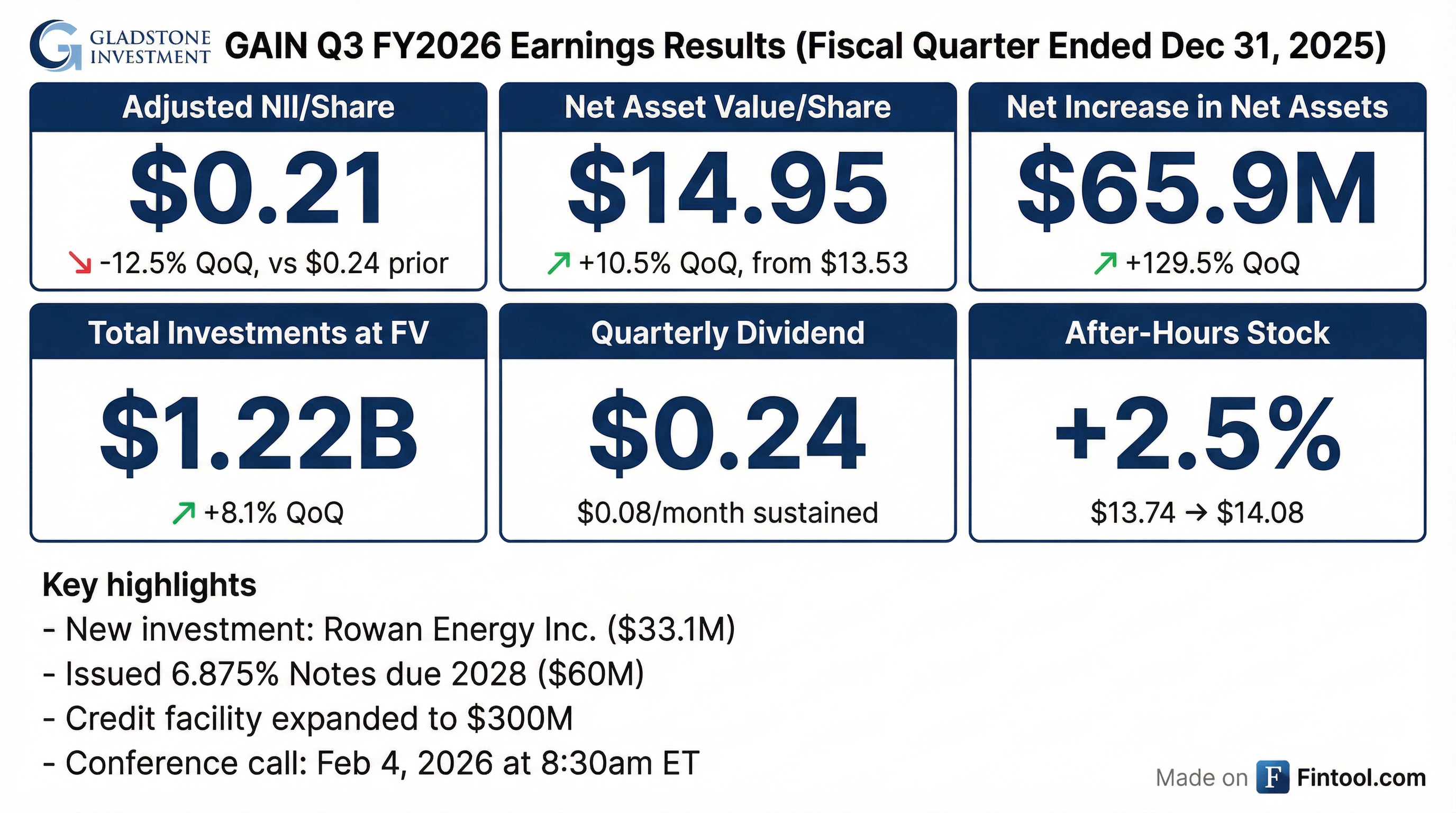
Gladstone Investment Corporation (NASDAQ: GAIN) reported Q3 FY2026 results for the fiscal quarter ended December 31, 2025, delivering a strong 10.5% increase in NAV per share to $14.95 driven by $70.2 million in net unrealized appreciation on portfolio investments. While adjusted net investment income declined 12.5% to $0.21 per share, the net increase in net assets from operations surged 129.5% quarter-over-quarter to $65.9 million.
The stock closed regular trading at $13.74 (-0.8%) but rallied to $14.08 in after-hours trading (+2.5%) following the earnings release.
Did Gladstone Investment Beat Earnings?
Mixed results with strong NAV growth but softer NII.
The GAAP net investment loss of $(6.5) million was driven by $14.7 million in capital gains-based incentive fees accrued under GAAP accounting—these fees are not contractually due under the investment advisory agreement but must be recorded when unrealized gains exceed losses. Excluding this non-cash expense, adjusted NII was $8.2 million ($0.21/share).
Total investment income was essentially flat at $25.1 million vs. $25.3 million in Q2, with a slight decrease in dividend/success fee income offset by higher interest income from a larger portfolio.
 Ask Fintool AI Agent
How Did NAV Per Share Change?
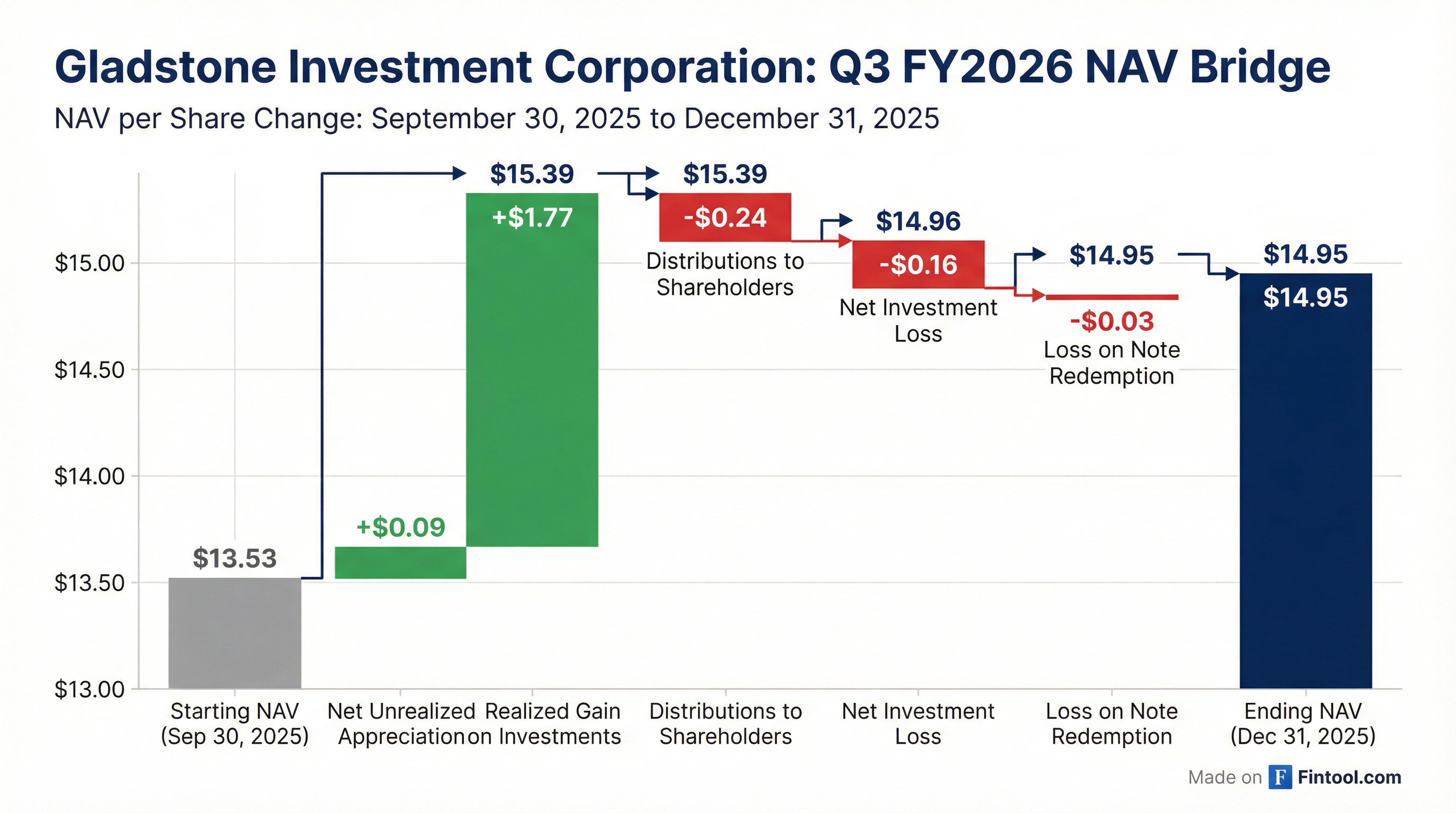
NAV per share increased $1.42 from $13.53 to $14.95, with the following drivers:
The $70.2 million in net unrealized appreciation reflected broad-based improvement across the portfolio, with fair value now representing 115.5% of cost (up from 109.0% in Q2).
What Did Management Do With Capital?
Portfolio Activity:
- New Investment: Invested $33.1 million in Rowan Energy Inc., a new portfolio company specializing in frac sand filtration and completion-equipment support in Oklahoma—$25.8M secured first lien debt + $7.3M preferred equity
- Total dollars invested: $37.4M (down 47% from $71M in Q2)
- Repayments/proceeds collected: $19.2M (up from $1.4M)
Financing Activity:
- Issued $60M of 6.875% Notes due 2028
- Redeemed $74.8M of 8.00% Notes due 2028 (reducing interest costs)
- Expanded credit facility from $270M to $300M
ATM Program:
- Sold 230,930 shares at weighted-average $14.03/share (above NAV)
- Raised approximately $3.2M net proceeds
What Is The Current Debt Structure?
Funding mix: 77.7% fixed rate, 22.3% floating rate . The credit facility has $171.4M of adjusted availability remaining.
How Sustainable Is The Dividend?
GAIN maintained its monthly distribution of $0.08/share ($0.24/quarter), with the next three monthly payments declared through March 2026.
While adjusted NII fell below the distribution this quarter, GAIN maintains substantial spillover income ($0.58/share) and total distributable earnings of $2.73/share, providing significant cushion.
Ask Fintool AI AgentHow Did The Stock React?
The stock trades at a 7% discount to NAV ($14.95), suggesting the market may not yet be fully pricing in the unrealized appreciation. The post-call rally indicates positive investor reception to management's commentary on portfolio strength and non-accrual outlook.
What Changed From Last Quarter?
Positives:
- NAV per share up 10.5% on strong unrealized appreciation
- Fair value/cost ratio improved to 115.5% from 109.0%
- Portfolio expanded to 29 companies (from 28)
- Successfully refinanced debt at lower rates
Negatives:
- Adjusted NII declined 12.5% to $0.21/share
- Weighted-average yield on debt investments fell to 12.9% from 13.4%
- NII coverage of dividend dropped below 100%
Unchanged:
- Monthly distribution held at $0.08/share
- Investment strategy focused on lower middle market acquisitions
What Did Management Say on the Earnings Call?
On Portfolio Appreciation Drivers:
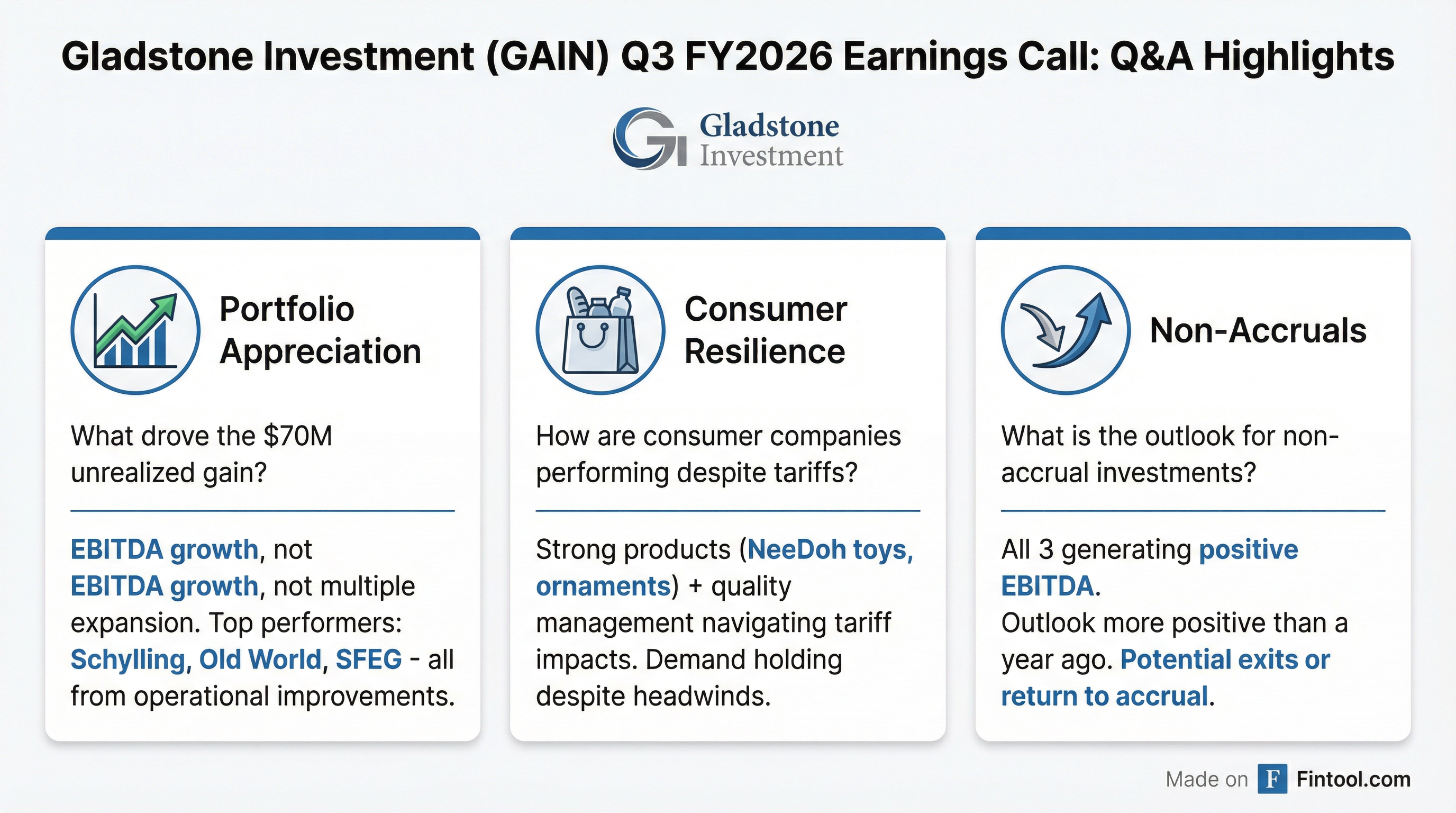
President David Dullum confirmed that the major valuation increases at Schylling, Old World Christmas, and SFEG were driven by EBITDA growth, not multiple expansion—"which is obviously the best situation."
On Consumer Company Resilience:
Despite broader consumer headwinds and tariff concerns, Dullum highlighted strong product differentiation: "Schylling has a very unique product, something called NeeDoh... that product has had huge demand, even with the tariff increases... they have literally been able to maintain a level of demand that just frankly has allowed the company to perform at an exceptionally high level."
On Rate Protection:
CFO Taylor Ritchie emphasized the floor rate protection: "With over half of our debt portfolio currently at their interest rate floors, we believe our yield is well protected against future rate declines." The weighted average floor for the portfolio is 12.1%, with new investments underwritten at 13-13.5% floors.
On AI Exposure:
When asked about AI risk to portfolio companies, Dullum noted GAIN is "more a beneficiary than necessarily where we have a tech company that might be directly in that space." Several portfolio companies are using AI for product design and efficiency improvements.
What's the Pipeline Outlook?
Pipeline remains "very healthy" and similar to a year ago. Management continues to pursue add-on acquisitions for existing portfolio companies to grow value.
Competitive Dynamics: GAIN's ability to provide both debt and equity gives it a "slight edge" in competitive auctions, as they can "speak for the whole capital stack" versus traditional PE firms that must source debt separately.
What's the Non-Accrual Outlook?
Three investments remain on non-accrual (3.8% of portfolio at cost, 1.5% at fair value). However, management expressed increased optimism:
"The ones that are currently on non-accrual, in differing degrees, I feel better about them honestly today than if you'd asked me that question perhaps a year ago... we might even see a potential exit, and certainly improvement to the point where we actually will be able to get them back on accrual." — David Dullum, President
All three companies are generating positive EBITDA, with structural reasons for the non-accrual status rather than operational distress.
Ask Fintool AI AgentWhat's Next?
- Interest Rate Sensitivity: 100% of debt investments are variable rate with floors; 52.1% currently at floor
- Rate cut impact: 100bp SOFR decrease would reduce weighted-average yield from 12.9% to 12.5%—not one-for-one due to floor protection
- Platform Strategy: Management continues to focus on platform companies with potential add-on acquisitions
Ask Fintool AI AgentData sources: GAIN 8-K filed February 3, 2026 , GAIN Q3 FY2026 Earnings Call Transcript , S&P Global Market Intelligence